

Replace ICT labels with observable conditions#
Two traders can mark different order blocks on the same chart and both call the annotation obvious. That makes the label weak evidence. A journal becomes useful when it stores the rule beneath the label.
For every ICT concept, write:
- the required prior structure;
- the numerical or bar-based trigger;
- whether a wick or close is required;
- the earliest confirmation timestamp;
- the invalidation condition;
- the session and timeframe;
- the data source and any missing-bar warning.
For example, “bullish FVG” can be defined as a three-candle condition where low[i] > high[i-2]. A backtest still needs a minimum gap, formation time, entry rule, expiry, and invalidation. Without those choices, two reviews can use the same name and test different strategies.
Separate context, trigger, and execution#
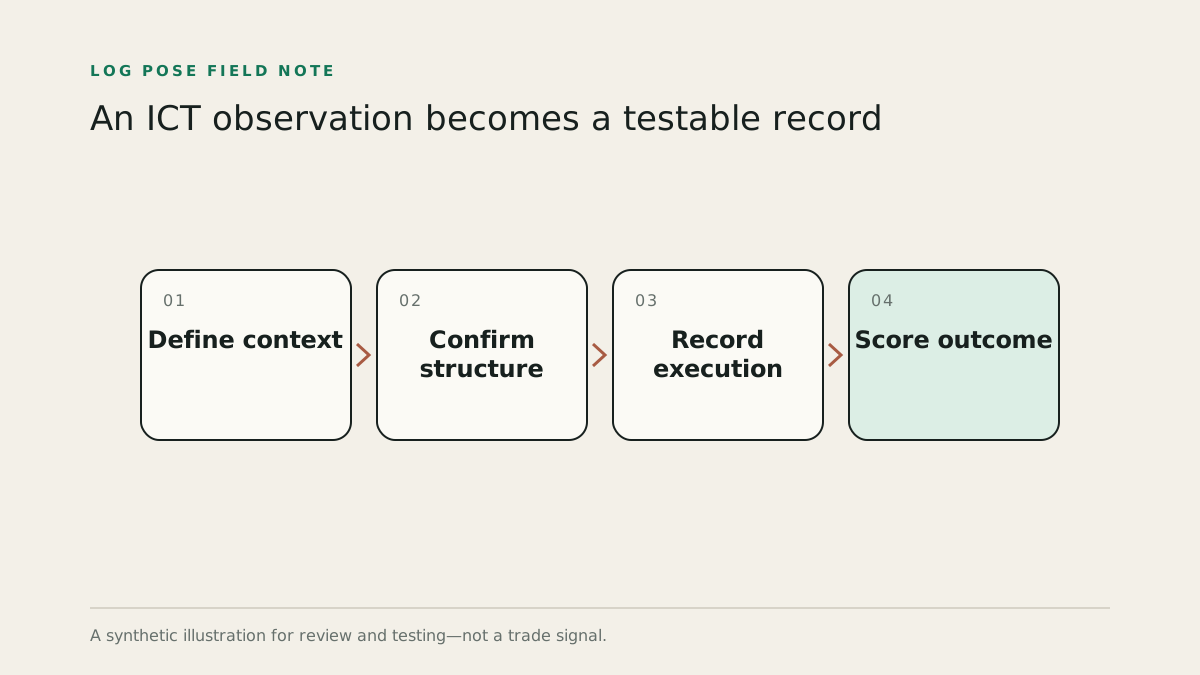
Use three layers in the journal.
Context describes where the market was before the decision: active range, premium or discount, prior session levels, and time of day.
Trigger describes the event that made the setup eligible: a sweep, confirmed break, displacement candle, or retrace into a defined zone.
Execution describes what you actually did: fill sequence, size, price, stop, additions, reductions, and exit.
Keeping these separate prevents a common rewrite. A trade may have good context but no valid trigger. It may have a valid trigger but a chased fill. P&L does not repair either gap.
Give every candidate a confirmation time#
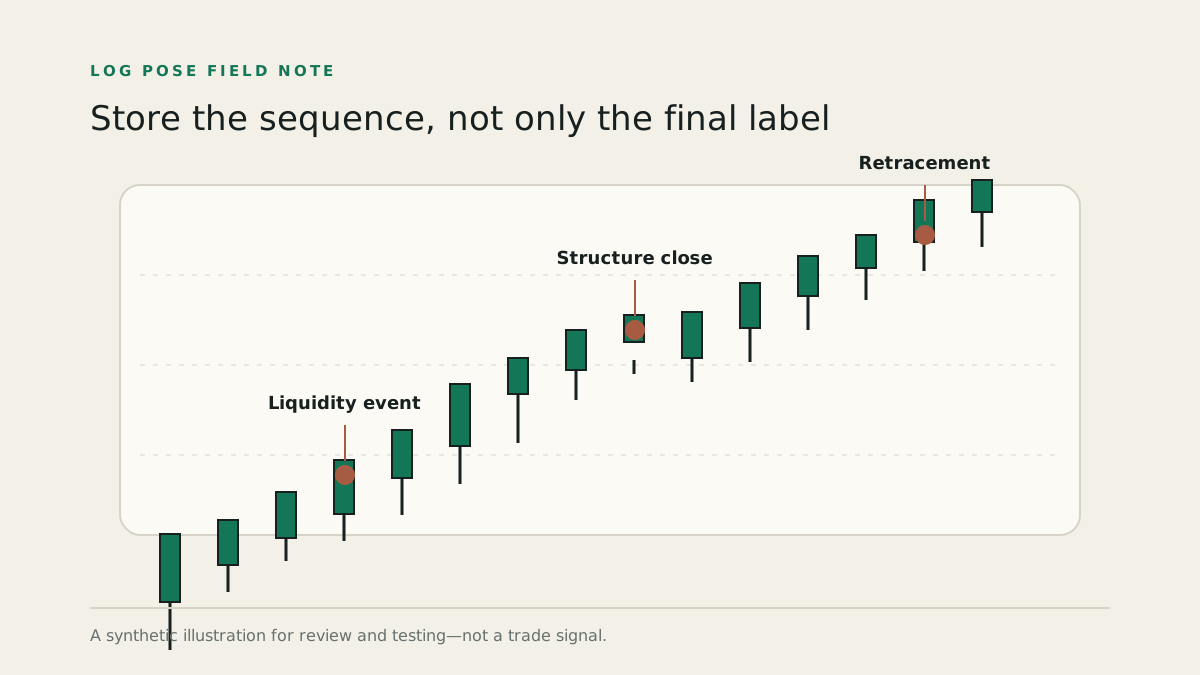
A swing is not confirmed at its high or low if your definition needs bars to the right. A three-candle FVG is not known on the first candle. A structure break requiring a close is not known while the bar is still developing.
Store both:
- event time: where the level or pattern appears on the chart;
- confirmation time: when a trader could first know it met the rule.
Backtests must enter no earlier than confirmation. A detector that draws a pivot on the pivot bar but trades it before the right-side bars close is looking ahead, even if the chart annotation appears visually correct.
Log Pose uses a pivot length of two, so a pivot candidate needs two bars on each side. It uses a structure-break buffer of max($0.01, 0.05 × ATR). These are operational choices for consistency, not universal ICT definitions.
Record the smallest complete setup contract#
A setup contract should fit on one screen:
| Field | Example test definition |
|---|---|
| Universe | liquid U.S. stocks and ETFs |
| Timeframe | 5-minute bars |
| Session | NY AM regular hours |
| Context | price below range equilibrium before reversal setup |
| Trigger | sell-side sweep, then confirmed bullish structure break |
| Entry | first retrace to qualifying bullish FVG midpoint |
| Expiry | cancel after 20 bars if unfilled |
| Stop | beyond sweep extreme |
| Exit | fixed target or separately defined management rule |
| Exclusions | corporate-action windows, missing bars, uncertain execution time |
The contract is not a recommendation. It is the definition required to compare like with like.
Journal the counterexample#
For each setup, save one near miss. Counterexamples expose which condition does real work.
If a candle sweeps a prior low but never closes back above the level, label it as a failed reclaim rather than a valid sweep under a reclaim-based definition. If a large candle looks like displacement but its body is mostly wick or its range is ordinary relative to ATR, record why it failed the threshold.
Near misses are not “bad trades” by default. They are a control group. Compare their forward outcomes with qualifying setups only after the rules have been frozen.
Use R only when initial risk exists#
R-multiple is realized P&L ÷ initial risk. The denominator must be the risk known at entry. Do not infer it from the final loss or from an arbitrary percentage of account value after the fact.
If initial risk was not recorded, show R as unavailable. This is more honest than producing a precise-looking metric from an invented stop. You can still review execution and outcome in dollars.
Turn weekly review into one test#
At the end of the week, do not change five variables. Choose one question:
- Did setups with a confirmed sweep behave differently from those without one?
- Did NY AM entries differ from NY PM entries under the same setup contract?
- Did midpoint limits reduce fill rate enough to offset their better entry price?
- Did anticipatory entries underperform entries after the confirming close?
Freeze the current definition, select the comparison, and state what would change your mind. Then test it on data not used to invent the rule.
An ICT journal earns its value when it makes disagreement visible and repeatable. It should not make every historical trade look as though the setup was obvious.
Sources and methodology#
Product details and workflows can change. Links below are the primary references checked for this page; the analysis and operational definitions are Log Pose’s.
- Log Pose Terms of Service — historical analysis boundaries — Log Pose
- CFTC Rule 4.41 — hypothetical performance limitations — U.S. CFTC / eCFR
Log Pose is not affiliated with Robinhood, Inner Circle Trader, or the products discussed on this page. This material is for education and recordkeeping, not investment advice. Historical and hypothetical results do not predict future performance.