

Profit is a result, not a process grade#
A trade can make money because the setup was sound, execution was controlled, and the market delivered the expected path. It can also make money after an impulsive entry, oversized risk, and a lucky reversal.
Likewise, a valid setup can lose. A stop can be reached even when the entry followed the rule and the risk was appropriate. If every loss is labeled a bad trade, the journal teaches you to abandon probabilistic rules after normal variance.
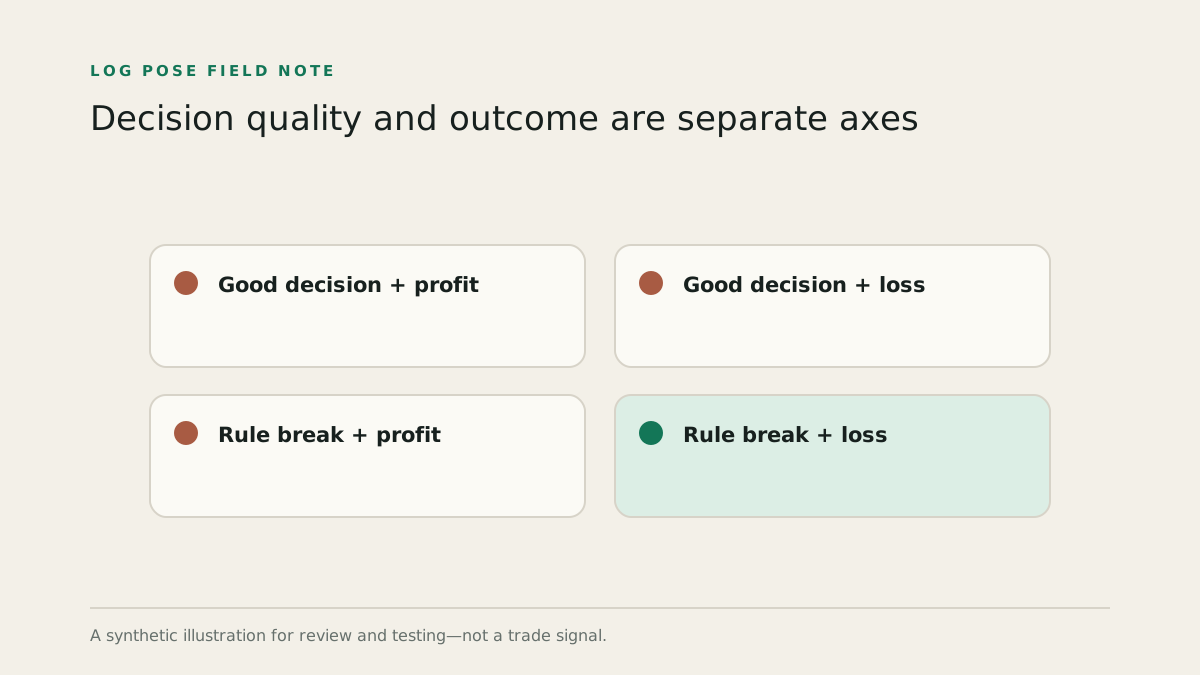
The review needs two axes:
- decision quality: was the action supported by your stated rule and the information then available?
- outcome: what was the realized result after costs?
Grade before opening the P&L column#
Hide the result and answer four questions.
Was the setup valid?#
List the conditions as observable events. “Looked bullish” is weak. “The five-minute candle closed above the confirmed pre-sweep swing by the required buffer” can be checked.
Did execution match the plan?#
Compare actual fills with the planned entry, quantity, and maximum chase distance. Preserve partial fills. A valid setup does not excuse an entry far outside the planned zone.
Was risk defined?#
Record the initial invalidation and dollar risk known at entry. If no initial risk was recorded, say so. Do not infer a convenient stop after the trade.
Did management follow its own rule?#
Grade stop movement, additions, scale-outs, and time exits separately. Management should respond to defined market information, not receive a passing grade because the final exit was profitable.
Only after these answers are saved should the outcome be revealed.
Use the four quadrants differently#
| Category | What it tells you | Appropriate response |
|---|---|---|
| Good decision, profit | Process and outcome aligned | Keep observing; one win proves little |
| Good decision, loss | Expected variance or incomplete rule | Preserve the example and compare a larger sample |
| Rule break, profit | Positive reinforcement for a weak process | Correct the behavior despite the reward |
| Rule break, loss | Process failure with visible cost | Identify the smallest preventable decision |
The most dangerous category is often the bad win. It pays you to repeat a rule violation. Mark it clearly and review it alongside bad losses.
Write evidence, not character judgments#
“Undisciplined” says little about the next action. Replace it with the event:
- entered before the confirmation bar closed;
- added after the invalidation level was touched;
- risked $240 against a prewritten $100 limit;
- moved the stop without a rule-based trigger;
- changed the setup tag after seeing the winner.
Each statement points to a controllable process. None claims that a single trade reveals your character.
Do not grade the setup with future candles#
Outcome bias often enters before P&L is displayed. A full chart shows that price later respected a level, making the original setup appear clearer.
Stop the chart at the exact decision time. Distinguish closed candles from the candle in progress. For a pivot needing right-side confirmation or a structure break needing a close, use the confirmation clock—not where the annotation is eventually drawn.
Compare matched decisions#
One good loss and one bad win are examples, not estimates. Group trades only when their setup definitions, session, timeframe, entry, and risk rules match.
Then compare:
- rule-following versus rule-breaking trades;
- anticipatory versus confirmed entries;
- planned versus chased fills;
- fixed-risk versus missing-risk trades.
Report sample sizes beside every result. A 75% win rate over four trades should not overrule a stable process built on a broader sample.
A ten-minute review exercise#
Choose the last five profitable trades. Hide their outcomes and regrade setup, execution, risk, and management from the chart at each decision time. Then do the same for five losses.
Write one rule violation that appears in both groups. That is a stronger improvement target than the behavior found only in losing trades, because it is less likely to be a story created by P&L.
The purpose of the distinction is not to ignore results. It is to make results teach the right lesson.
Sources and methodology#
Product details and workflows can change. Links below are the primary references checked for this page; the analysis and operational definitions are Log Pose’s.
- Investor Bulletin: Performance Claims — U.S. SEC
- Log Pose Terms of Service — no investment advice — Log Pose
Log Pose is not affiliated with Robinhood, Inner Circle Trader, or the products discussed on this page. This material is for education and recordkeeping, not investment advice. Historical and hypothetical results do not predict future performance.