

Reconstruct the trade before interpreting it#
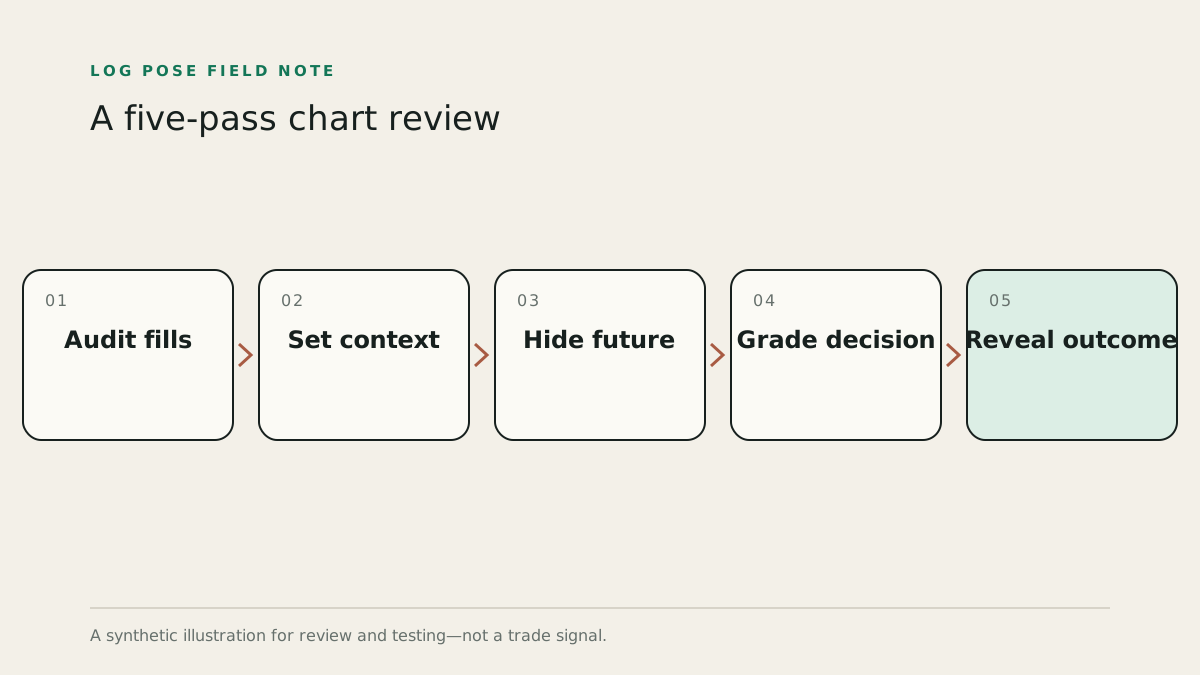
The chart review is only as reliable as the execution record underneath it. Start by listing every fill in chronological order. Do not begin with a screenshot of the cleanest entry marker or with the final average price.
For each fill, preserve:
- execution time and its precision;
- side and quantity;
- execution price;
- order identifier when available;
- whether the fill opened, added to, reduced, or closed the position.
Then group the fills into a position episode. For a long equity trade, buys increase the open quantity and sells reduce it. The episode ends when the quantity returns to zero. A new position in the same symbol later that day is a separate episode unless you had a prewritten rule that treats it as one campaign.
This matters because chart review follows the decisions, not just the ticker. Combining two separate attempts can hide that the first thesis failed and the second used different information.
Give the entry enough left-side context#
A chart centered tightly on the entry makes almost any setup look intentional. Load enough pre-entry bars to answer four questions:
- What was the last confirmed swing high and low?
- Where was price relative to the active range?
- Had liquidity already been taken, or are you labeling the event after the fact?
- Which session was open, and was the market near an event or opening auction?
The correct amount of context depends on the timeframe. A five-minute entry may need the prior regular session plus the current premarket or opening range. A daily entry may need months. Use a written context rule—such as “show the previous session and all bars since today's open”—instead of zooming until the story looks persuasive.
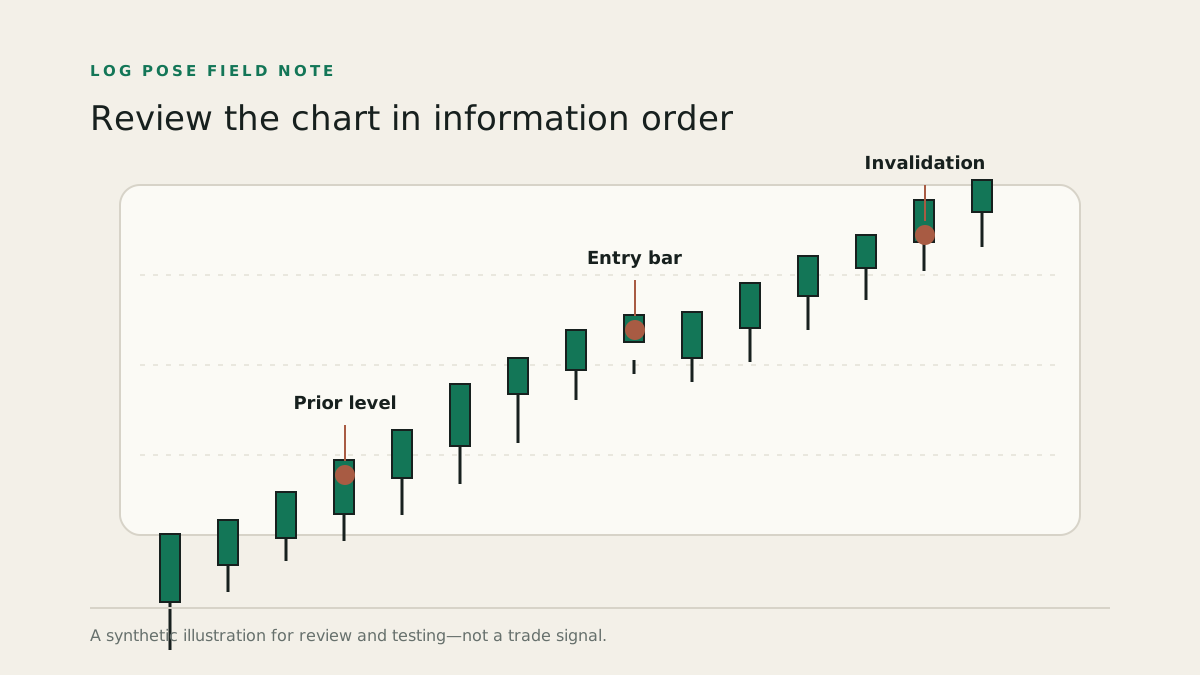
Stop the chart at the decision#
The most common review error is subtle: you know the next candle. That knowledge changes how obvious a sweep, FVG, or structure break appears.
For an entry at 10:17:34 a.m., the 10:15–10:20 five-minute candle was not closed. A rule requiring a close above structure cannot use that candle's final close at 10:17. Your review should distinguish:
- closed-bar information, which was fully known;
- developing-bar information, which was partial;
- future information, which was unavailable.
If your setup requires confirmation on close, the earliest valid entry is after that close. A fill inside the confirmation candle is anticipatory, even if the candle eventually closes exactly as hoped.
Keep uncertainty visible#
Some broker activities are date-only. A date-only buy cannot be placed on a specific intraday bar. Use a daily marker or show it as “time unavailable.” Withholding an ICT classification is more useful than manufacturing a precise but false one.
Grade three things separately#
One score blurs different problems. Grade the trade on three axes before revealing outcome:
| Axis | Question | Example evidence |
|---|---|---|
| Setup | Did the observable conditions exist? | sweep confirmed, structure close, gap size |
| Execution | Did the fills match the plan? | distance from planned entry, partial fills, size |
| Management | Did exits follow the rule? | stop movement, scale-out, time stop |
A valid setup can receive poor execution. A weak setup can receive good risk management. Keep those distinctions because the corrective action differs.
For initial risk, use the amount you actually defined before or at entry. Do not reverse-engineer risk from the loss. If no initial stop or dollar risk was recorded, mark R-multiple as unavailable.
Use operational ICT definitions#
Terms such as displacement and market-structure shift are interpreted differently across traders. Review becomes consistent only when the rule can be computed from the same bars every time.
For example, Log Pose treats a displacement candidate as a candle whose true range is at least 1.5 × ATR, whose body is at least 60% of its range, and whose close is within the outer 20% of the candle. That is a product test definition, not a universal ICT law. Its value is repeatability: a future review cannot quietly lower the threshold because a winning trade almost qualified.
Apply the same discipline to sweeps, breaks, gaps, and order blocks. Record the threshold, confirmation time, and invalidation before comparing results.
Run a blind replay exercise#
Choose one profitable trade and one losing trade from the same setup.
For each:
- hide all bars after the entry;
- write the setup decision in one sentence;
- mark the exact invalidation known at entry;
- grade setup and execution without P&L;
- reveal five bars at a time and review management;
- reveal the final result last.
If your grades reverse only after P&L appears, outcome bias is running the review. The goal is not to make losing trades feel good. It is to find whether your rules distinguish decisions before the outcome becomes known.
Finish with a rule, not a verdict#
“Good trade” and “bad trade” end the conversation. A useful review ends with a bounded instruction:
- “Wait for the five-minute close above the pre-sweep swing.”
- “Do not add after price has moved more than 0.25 ATR from the planned entry.”
- “When execution time is date-only, exclude the trade from intraday setup statistics.”
The next session can test each statement. That is what turns a Robinhood fill history into a review system.
Sources and methodology#
Product details and workflows can change. Links below are the primary references checked for this page; the analysis and operational definitions are Log Pose’s.
- Finding your reports and statements — Robinhood
- Account Data: Orders and Activities — SnapTrade
Log Pose is not affiliated with Robinhood, Inner Circle Trader, or the products discussed on this page. This material is for education and recordkeeping, not investment advice. Historical and hypothetical results do not predict future performance.