
Confirm the reference level first#
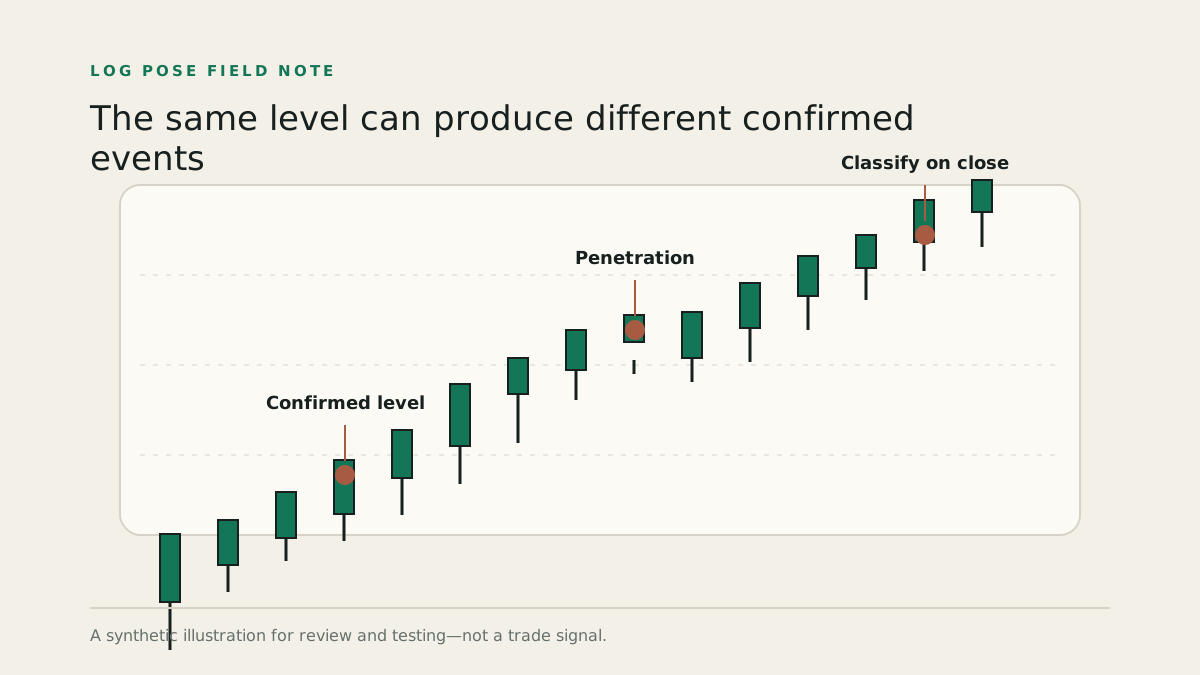
A sweep or breakout needs a level that existed before the event. Define how the level becomes confirmed.
For a pivot-based rule, a swing high might require two lower highs on each side. That means the swing is confirmed two bars after the high itself. A backtest cannot use the level during those right-side bars.
Other valid references include prior-day high or low, session high or low, or an opening range. State which one is eligible. Do not choose the level after seeing where price reverses.
Require meaningful penetration#
A one-cent wick through a volatile stock's prior high may be noise. Use a buffer that adapts to price or volatility.
Log Pose tests a break buffer of:
max($0.01, 0.05 × ATR)
For a high at $100.00 and ATR of $0.80, the buffer is $0.04. A qualifying trade beyond the level must reach at least $100.04. This is one operational threshold, not a universal market rule.
Define reclaim and acceptance#
For a high-side event:
- a sweep candidate trades above the buffered prior high and then closes back below the level under a reclaim-based definition;
- a breakout candidate closes beyond the buffered high and meets whatever persistence or follow-through condition your rule requires.
Reverse the logic for a prior low.
The close requirement matters. A wick beyond a level during a still-open candle cannot be called a completed sweep or breakout if your definition waits for the close.
Do not define a sweep as “price later reversed” or a breakout as “price continued.” That uses outcome to name the setup. A sweep can reclaim and later fail upward; a breakout can accept and later reverse.
Give ambiguous events their own bucket#
Some bars close almost exactly on the level. Some feeds differ by a tick. Some bars sweep one reference while breaking another. Mark those events ambiguous when the classification changes inside your stated tolerance.
Useful ambiguity rules include:
- exclude closes within one tick of the boundary;
- require the same classification on two approved data feeds for research samples;
- store simultaneous high-side and low-side runs as a separate outside-bar event;
- exclude missing-bar or corporate-action windows.
An ambiguity count is evidence about the rule's fragility. Hiding it makes the sample look cleaner than it is.
Test the event before the setup sequence#
First measure sweep and breakout candidates without adding MSS, FVG, session, or premium/discount filters. Report occurrence count and forward path under a fixed horizon.
Then add one sequence condition, such as:
After a sell-side sweep is confirmed, require the first bullish close above the pre-sweep swing by the structure buffer.
That lets you distinguish the value of the sweep event from the value of the full sequence.
A practical chart exercise#
Choose 30 previously confirmed swing levels. Hide all candles after the first penetration and record:
- level type and confirmation time;
- ATR and buffer;
- maximum penetration;
- close relative to the level;
- sweep, breakout, or ambiguous classification;
- classification timestamp.
Reveal the next ten bars only after the labels are frozen. Compare forward outcomes, but do not rename events based on them.
The useful question is not whether sweeps are “real.” It is whether your definition can classify them consistently before the future path is known.
Sources and methodology#
Product details and workflows can change. Links below are the primary references checked for this page; the analysis and operational definitions are Log Pose’s.
- Log Pose Terms of Service — historical analysis boundaries — Log Pose
- CFTC Rule 4.41 — hypothetical performance limitations — U.S. CFTC / eCFR
Log Pose is not affiliated with Robinhood, Inner Circle Trader, or the products discussed on this page. This material is for education and recordkeeping, not investment advice. Historical and hypothetical results do not predict future performance.