

The practical verdict#
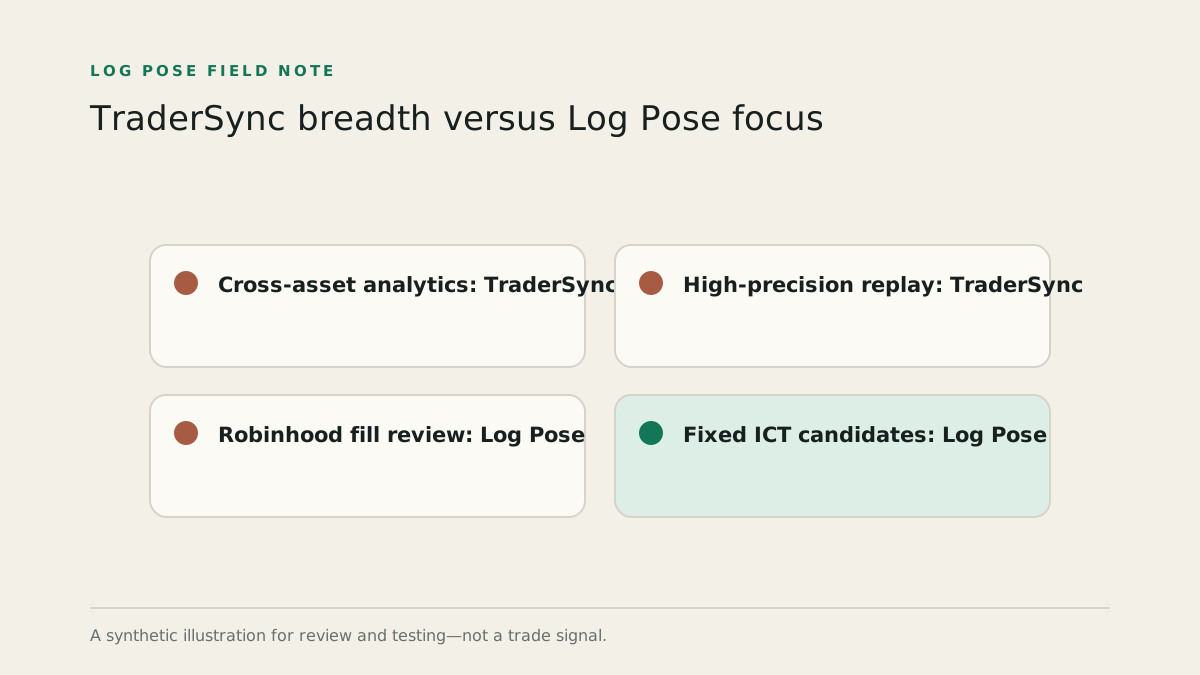
TraderSync is a broader journal and replay platform. Its official pages describe stock, options, futures, forex, crypto, CFD, and index support; a large supported-broker directory; analytics; strategy planning; replay; and AI coaching. Log Pose focuses on one narrower audience: Robinhood stock and ETF traders who want executions reconstructed on a chart and reviewed against deterministic ICT rules.
If you would use TraderSync's asset breadth, replay precision, or analytics, those are substantial advantages. If those features become navigation around one repeated Robinhood review task, Log Pose may fit better.
Choose TraderSync if#
- you trade several asset classes or accounts;
- you need a large importer directory rather than Robinhood-only scope;
- market replay is a primary training environment;
- options backtesting, tape, Level II, or sub-second replay matters to your plan;
- AI coaching and a wide performance-report surface are valuable;
- you want planning, journaling, replay, and analytics in one mature platform.
TraderSync's pricing page says its highest tier can replay trades and quotes at precision down to 250 milliseconds and includes tape, Level II, and AI coaching features. Plan boundaries matter, so compare the live tier table rather than assuming every capability exists in the lowest plan.
Choose Log Pose if#
- Robinhood stock and ETF fills are the record you need to review;
- your first question is where the real fills occurred relative to structure;
- you want fixed definitions for sweeps, BOS, MSS, displacement, FVG, order-block candidates, and OTE;
- you want to confirm or dismiss detected candidates instead of manually redrawing every label;
- two bounded backtest presets cover the rules you are actively studying;
- a smaller workflow is more valuable than cross-asset coverage.
Feature and fit comparison#
Facts below were checked against official pages on September 2, 2026. TraderSync discounts and plan limits can change.
| Question | Log Pose | TraderSync |
|---|---|---|
| Primary fit | Robinhood stock/ETF ICT review | Broad journal, analytics, planning, and replay |
| Broker scope | Robinhood only | Large supported-broker directory; Robinhood is listed |
| Robinhood import method | Read-only connection is the core workflow | Check the live broker row for current auto-sync versus file-import status |
| Asset scope | Stocks and ETFs in current scope | Stocks, options, futures, forex, crypto, CFDs, and indices described by TraderSync |
| Replay | Reconstruct completed fills; bounded historical backtests | Trade Replay and Market Replay; precision/features vary by tier |
| ICT model | Deterministic candidates and two presets | User-defined strategies, notes, analytics, and replay rather than Log Pose's fixed ICT detector |
| AI | Not the product focus | Cypher assistant and coaching features vary by plan |
| Monthly list price | $19 after trial | Pro $29.95, Premium $49.95, Elite $79.95 at verification; annual promotions displayed separately |
The TraderSync supported-broker page explains that only entries marked for auto-sync use a direct connection; others use file upload. Because its searchable table can change, verify Robinhood's current row before choosing solely on automation.
The ICT difference is structure, not vocabulary#
TraderSync lets traders define strategies and analyze them across a broad journal. That flexibility is useful when your ICT playbook is already formalized or when you trade concepts beyond Log Pose's detector.
Log Pose encodes a small set of operational definitions. For example, displacement must pass ATR, body-ratio, and closing-location thresholds. An FVG must pass a minimum size. A market-structure shift follows a confirmed sweep and opposing break under the product rule. These are candidates, not signals or universal ICT definitions.
The benefit is consistency; the cost is less freedom. Choose based on whether you want a framework to configure or a narrow framework to challenge.
Compare one real session#
Use the same five Robinhood trades:
- verify whether every fill and partial fill imports;
- time how long it takes to reach the chart review;
- reproduce one setup definition without changing it per trade;
- inspect whether future candles leak into the classification;
- produce a weekly action you can test next session.
Also note which TraderSync features you would actually use. A longer feature list is valuable only when it replaces real work. A narrower product is valuable only when its narrow workflow matches your account and method.
Sources and methodology#
Product details and workflows can change. Links below are the primary references checked for this page; the analysis and operational definitions are Log Pose’s.
- TraderSync pricing — TraderSync
- TraderSync supported brokers — TraderSync
- TraderSync features — TraderSync
- Log Pose pricing and product scope — Log Pose
Log Pose is not affiliated with Robinhood, Inner Circle Trader, or the products discussed on this page. This material is for education and recordkeeping, not investment advice. Historical and hypothetical results do not predict future performance.